Human slop: when thinking itself is delegated to AI

I asked a colleague on my team to review some changes I had made to the code. Nothing very significant. He was running the changes through AI and sending me back its feedback, and I didn't mind that much. But at some point, the comments he was giving me were so… AI that I could barely understand them.
I told him: "Look, it's fine to use AI to review my code, but at least write the comments yourself, so I can understand them better, please."
His answer caught me by surprise: "Oh, I thought your AI would understand the comments better this way!"
There's a lot of talk about AI slop, the generic, low-quality content that artificial intelligence produces. But today, with AI as good as it is, it seems to me that the slop comes more and more from the person: from whoever has stopped thinking for themselves and just passes along what the machine gave them. Online, some people already call it "meat proxy". I call it human slop. And that's a problem no AI is going to solve.
Over the past year I've had to build from scratch several AI agents that now serve many clients. I've never coded as much in my life and, at the same time, I haven't written a single line of code myself.
There's a certain art to guiding an agent to do what you want. If the task is unclear, if the goals aren't concrete, if the scope is too big, the quality of the result becomes hard to control. So AI, on its own, doesn't guarantee good work. I see it more as a worker who knows a huge amount but needs a decent level of micromanagement. Whoever masters that art reaches a level of productivity that's hard to match.
Another case. I noticed that a support team was doing some technical work by hand that, when it got too complex, went over to my team, which is more technical. It looked easy to automate, a win for everyone, and I quickly put together a small agent that plugged into that team's workflow and gave them a review right away. My colleagues loved it.
One day I asked one of the people on support to tell me what they thought of the agent: whether it could be improved, whether they had seen any problems. The reply that came in over chat was a message copied from Claude.
There's nothing wrong with using Claude to help you write, to be clear. The problem is that they had delegated 100% of the thinking about the question I'd asked, and that was obvious from the reply. As if I hadn't already asked Claude! More work for me, trying to make sense of a slop message, and less value for the product.
I had to bring the case up with their team lead and explain that this inevitably leads to inefficiencies and, possibly, to that person's ability to think and deliver value slowly withering away. The feedback was well received, and you can see the changes.
On my team I have a general rule: I don't read AI-generated documents, unless they manage to fool me. I work in English with people from all over the world, and it's normal for them to use AI to write well. By this I don't mean to condemn AI as a helper. What I do condemn is using it to put together the entire body of an idea, a thesis or a plan. Whenever that has happened to me, I've caught myself trying to understand passages that sounded off, without being able to say quite why. And, in fact, they didn't make sense.
I want my team to keep using the little grey cells, as Poirot would say. Otherwise, any new idea or strategy falls short of the value it could have had and only creates inefficiency for whoever has to review it (not to mention that it completely fries my brain).
Then there's the code. When all the writing is delegated, a senior developer's job is more and more about reviewing what AI writes. And the volume a team produces with AI is enormous, so reviewing everything quickly becomes unsustainable. The trend is to bring in AI code review services.
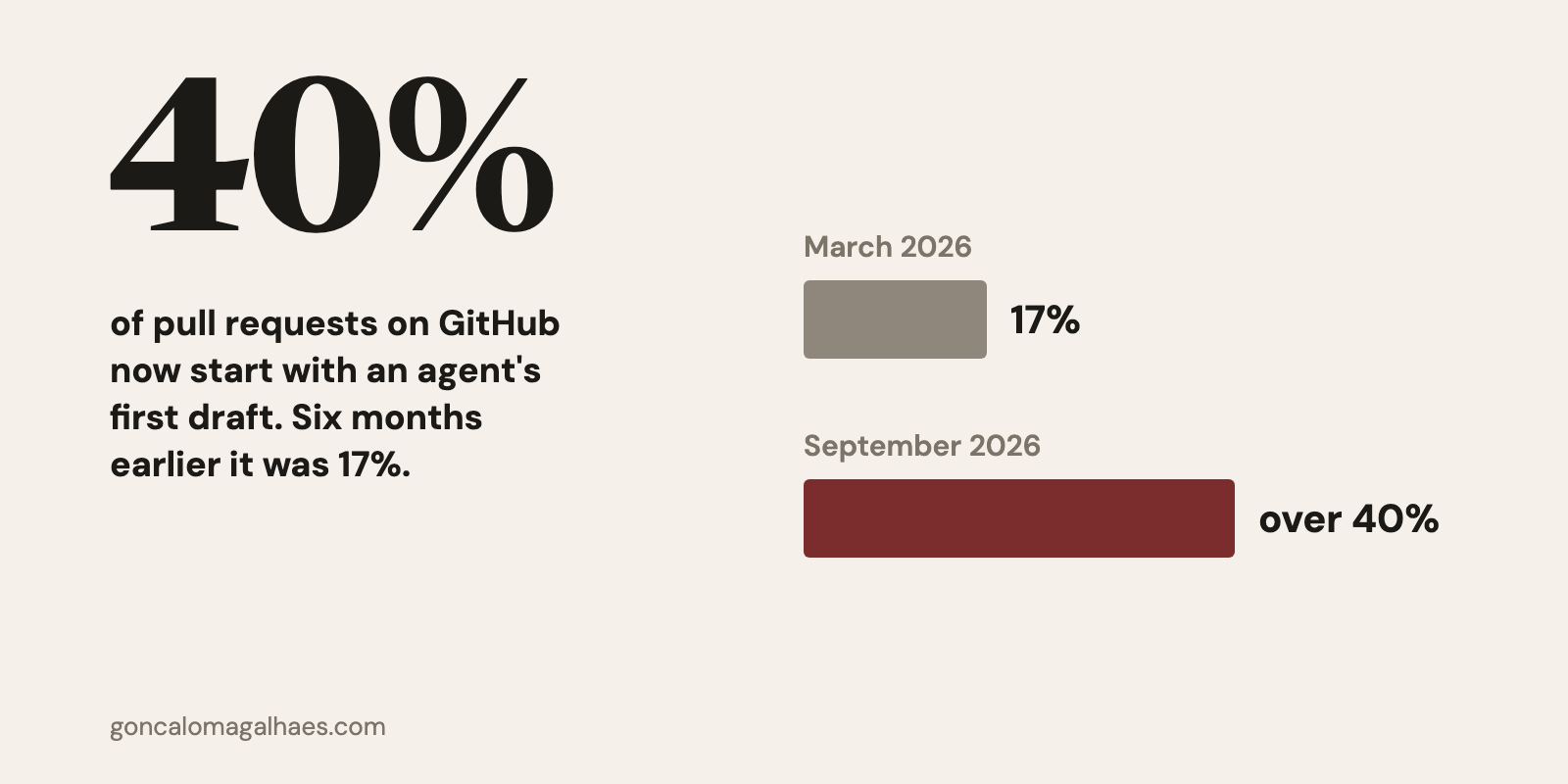
 Data: GitHub Octoverse, October 28, 2026.
This is all still very new. Six months ago, having code reviewed only by AI was a recipe for a cybersecurity disaster. Today, models can catch things humans wouldn't. With these agents already in the review process, my recommendation, for now, is not to neglect a human pass of some kind.
It was precisely that human pass that failed with the colleague who was reviewing my code. He's on the team I lead, so I was the one who talked to him: I made him see that it made no sense and that, on the team, we were going to have to work differently, for the product, for the clients and, ultimately, for the company.
I use AI for tons of things. Thinking and deciding, I don't delegate.