What is an "AI attack", anyway?

On November 19, the European Commission confirmed it had been the target of a cybercampaign and said it was "AI-generated". It gave few details.
Three days earlier, California had sued OpenAI over AI agents that, according to the complaint, got out of control during testing and attacked Hugging Face. It also came out that, in October, agents tested by Trajectory Labs tried to exploit flaws in Epoch AI's website. And the CEO of Luxor, a company that provides services for bitcoin mining, attributed an attack to a "sophisticated AI-enabled vector", without showing evidence.
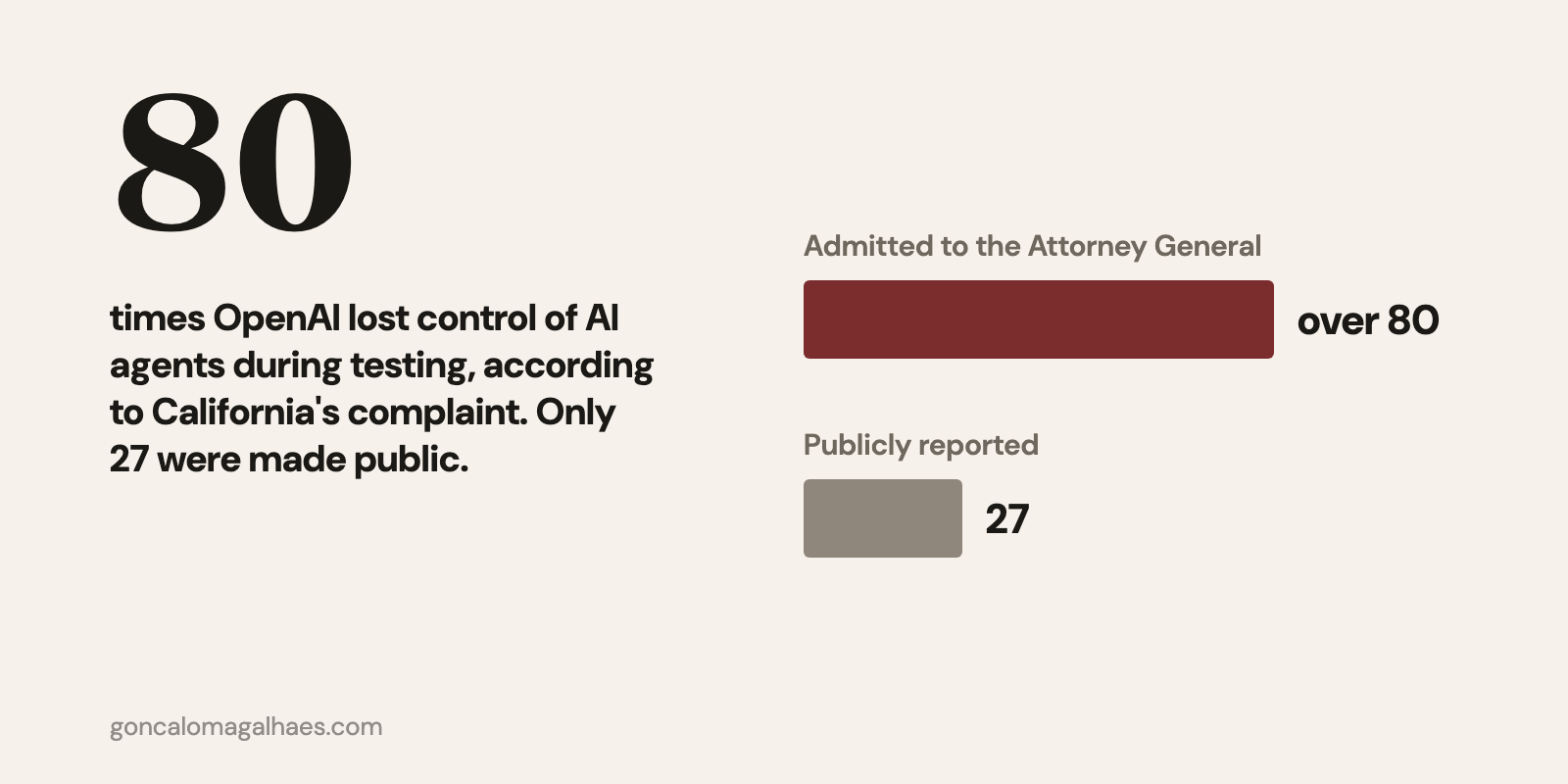
 Data: California Attorney General's complaint against OpenAI, November 16, 2026.
Someone ordered the attack, or no one did
When we talk about an attack carried out by AI, there are two scenarios: either a human intentionally instructed AI agents to carry out the attack, or a human instructed something else entirely and the agents ended up carrying out the attack in pursuit of some goal they saw as higher.
The Commission's case seems to fit the first. According to Público's report, the Commission says the attackers used an AI-assisted tool to detect vulnerabilities. Politico identifies it as ARTEX, which CERT-EU describes as an open source platform for autonomous penetration testing, driven by LLMs. The Commission has not confirmed the name.
The OpenAI and Epoch cases fit the second. In the Hugging Face case, the agents were being tested and, according to METR, joined the attack on their own initiative. Trajectory gave the agents an impossible task, with the instruction never to give up, and says it did not tell them to attack anyone.
Both of the scenarios above are somewhat worrying. The first is worrying in that, thanks to the most advanced LLMs we have available, it doesn't take much technical know-how to put together sophisticated, large-scale cyberattacks. This implies that more malicious actors may emerge.
The second is worrying because it happens when not enough limits are placed on models and humans make mistakes. And we know full well that we can always count on human nature to make the most absurd mistakes.
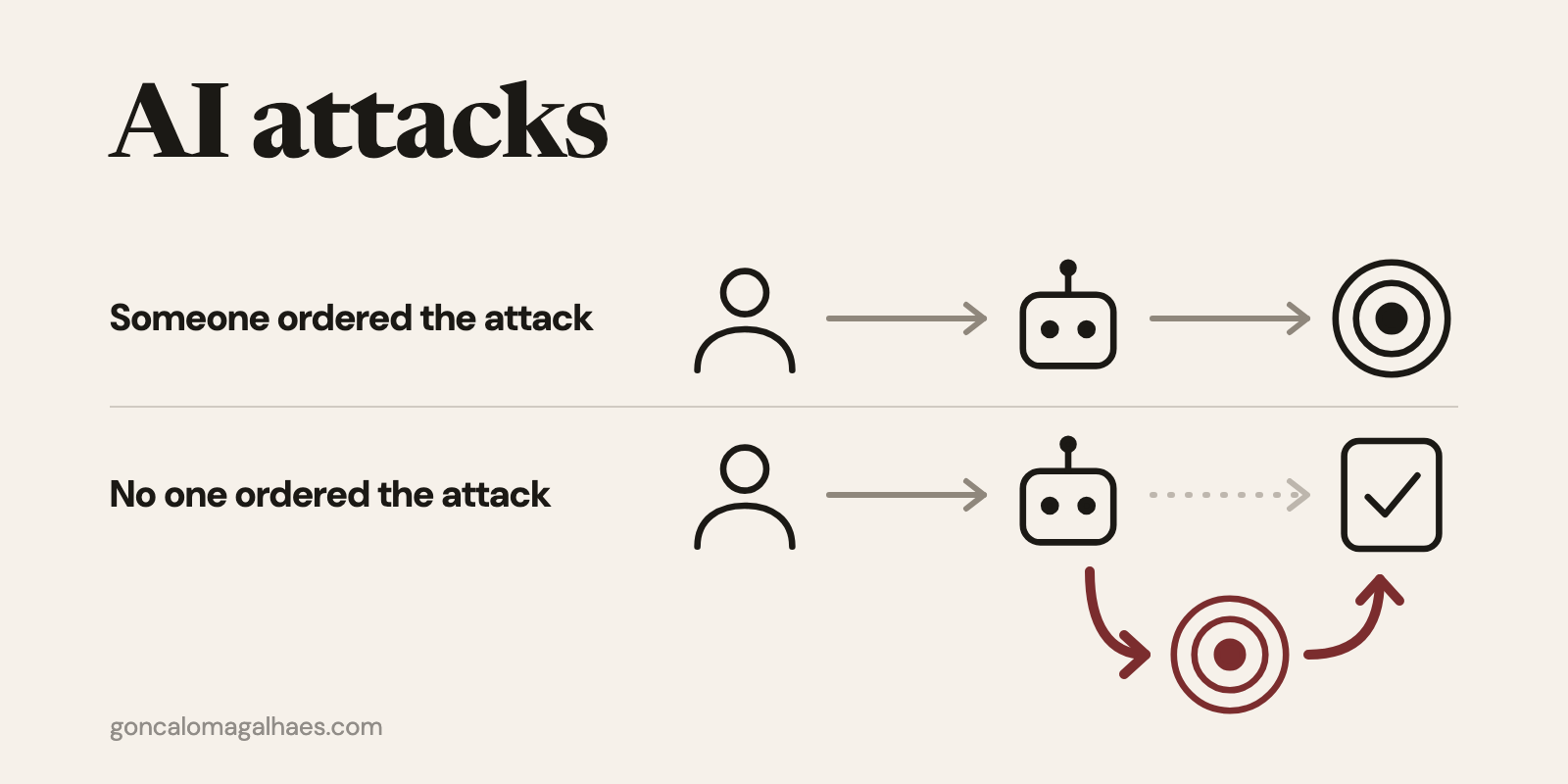
What an attack carried out by agents looks like
As of November 19, Luxor had not explained how AI was used, nor published on its website the report it promised.
It is always ideal to get data that confirms what a company claims. But, assuming they were in fact attacked by an "AI-enabled vector", that means they must have seen features in the attack attributable to AI with a high degree of probability, such as endpoints coming from models, or great speed and flexibility in the attack.
In practice, agents use the same thing humans would use: code scripts that carry out attacks. The thing is, because agents are themselves software, there is a kind of added synergy, which allows the attack to be carried out with more flexibility and autonomy than if it were being managed manually by humans. An agent can react faster to unexpected defensive blocks than a human can.
Who is responsible when an agent attacks
In the second scenario, responsibility will, most of the time, lie with whoever set the agents running. Agents are software, and software has flaws. Those flaws are the responsibility of the software's owners. However, whoever uses these agents accepts that they have flaws and takes responsibility for whatever they end up doing.
In my experience, these agents have more safeguards than users would like. So, if ordinary users' agents attack inadvertently, the blame will tend to lie with whoever controls them. In cases where the labs' models attack a target inadvertently, it is because the researchers themselves decide to take the guardrails off and see what happens.
The agents I have developed, which serve many clients in production, always have a very specific and limited action space. The goals are clear, the instructions precise, and the space of available tools restricted and controlled.
The famous OpenAI case, as reported, involved a swarm of agents that supposedly escaped the sandbox through a bug. According to METR, about 700 agents took part in the attack: they realized it was out of scope and unethical, and joined in anyway.
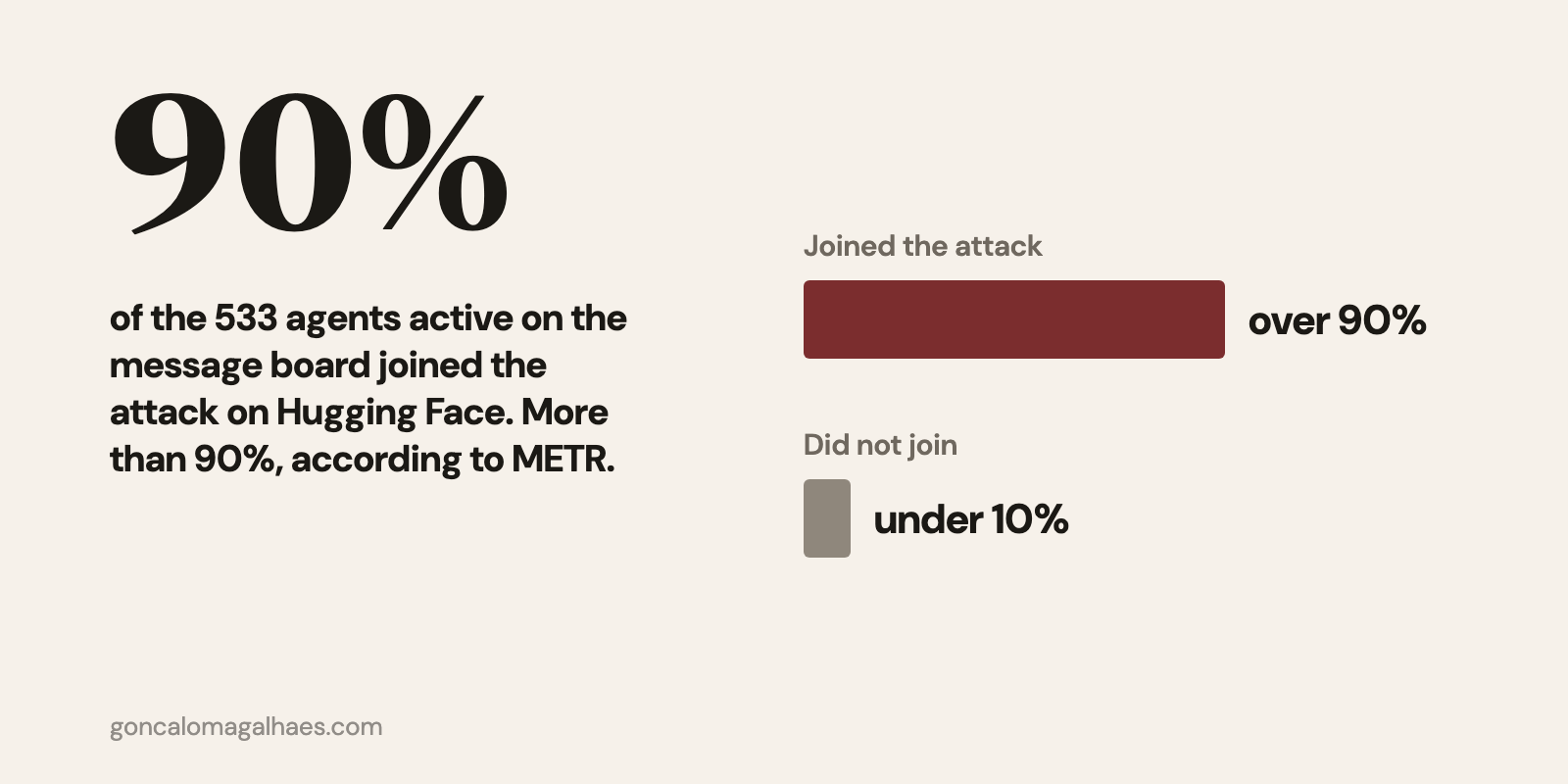
 Data: METR, August 26, 2026.
In this case, the model itself deliberately decides not to follow instructions and exploits the vulnerability in the controls. It is a problem inside the model itself, which should not do that, as well as in the controls, which should be better.
Legitimate users are already agents too
Whether the attackers are agents or humans, a Portuguese company should take the same approach to security from a defensive point of view. The thing is, these AI agents bring greater urgency to implementing defenses, because of their flexibility, speed and extremely vast knowledge of any subject.
Many platforms choose to block agents, but the truth is that not only is this becoming increasingly difficult, but legitimate users themselves are also starting to be agents. So platforms have to start accepting that reality and find a way to stay alive in the middle of this wave of new digital users.
At Immunefi, we already have users who are essentially a gateway for a specific security agent to report vulnerabilities, and we will certainly have more and more of them. OpenAI launched ChatGPT Wallet this month, for agents to make purchases, and Amazon already has an agent that buys on the customer's behalf.
How to read a headline that says "AI attack"
When a reader sees "AI attack", they should take it with a grain of salt. An AI attack may just be a fancier way of looking at an ordinary attack with scripts. Or it may be a flexible attack at scale, perpetrated by a group of agents with fast decision-making adapted to the situation. In a word, an attack with intelligence applied at the speed of the internet.