AI in business: shrink first, grow later

The most immediate impact of AI on corporate work is the reduction in the time needed to get through a whole range of tasks. That impact is a kind of Matrix red pill: what, in the distant world of 2024, took a few days of work is now carried out well by an AI agent. A kind of junior worker you give an order to, but who has vastly more knowledge and executes at the speed of the internet.
This is the first of three phases AI goes through in companies.
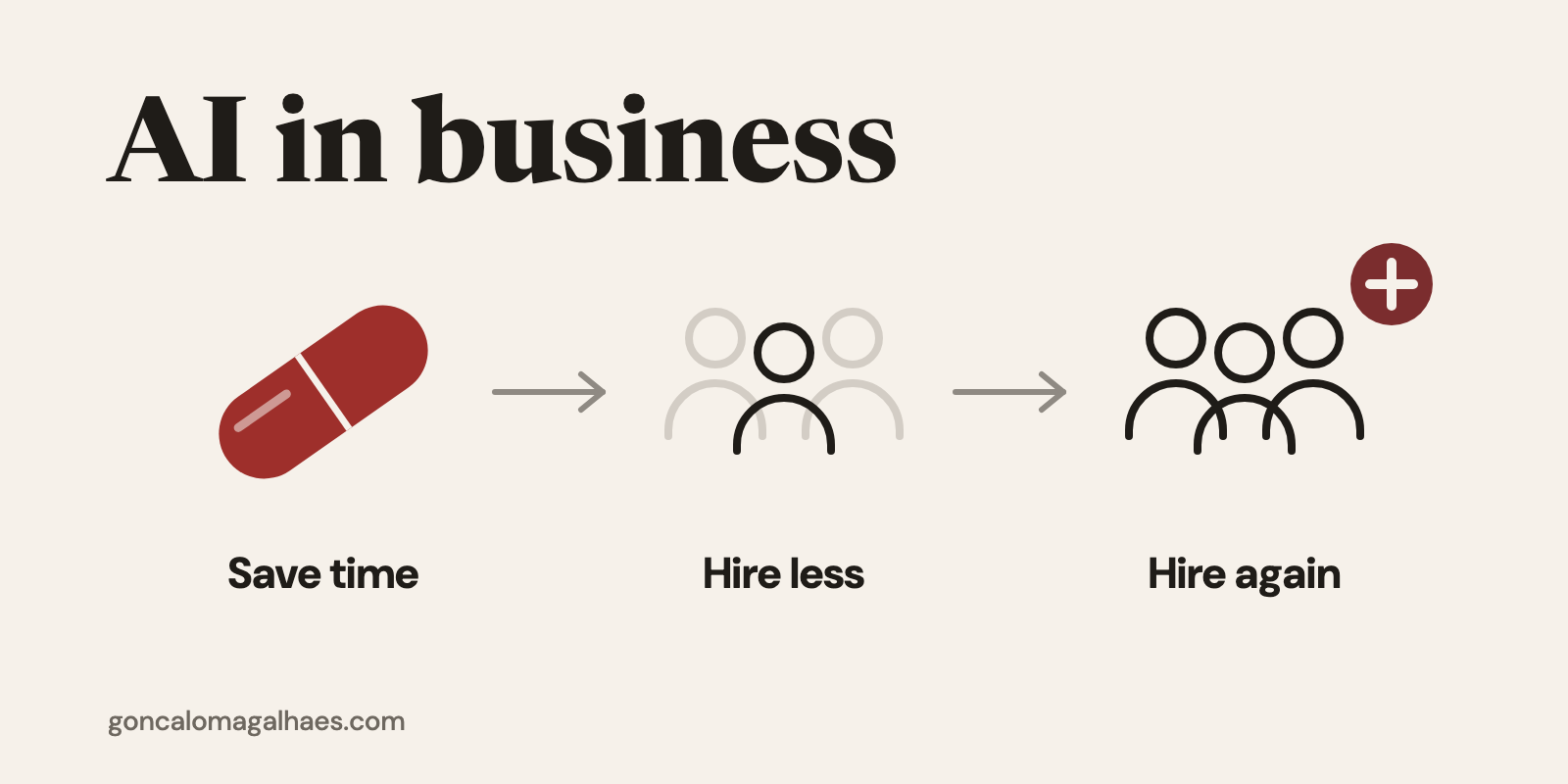
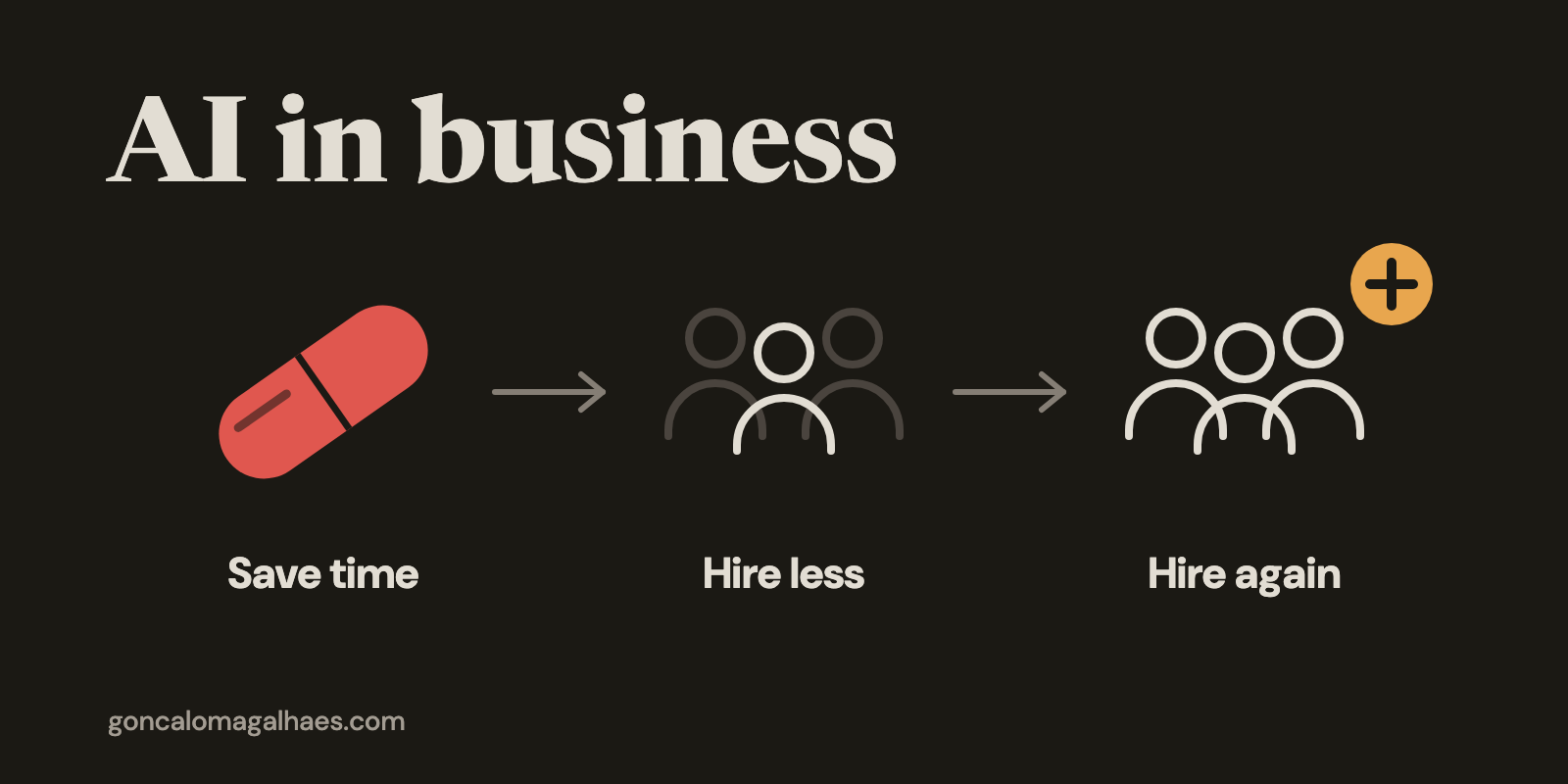
Automating as much as possible and hiring less
The next phenomenon is using AI and agents for as much automation as possible, sometimes even too much. It's in this phase that a senior worker may think that, in practice, there's no longer much need to have so many juniors, or even to have so many people executing on a specialist team.
On November 23, Anthropic, the company that develops Claude, published a report based on 66 interviews at 58 American companies. At two-thirds of them, people said they're hiring less because of AI. One of the interviewees put it this way: "We may not be firing, but we're not hiring."
In the same report, six startups that were born already working with AI estimated that, without it, they would need, on average, four times as many employees.
The authors saw few layoffs due to AI among the folks they interviewed, but they warn that the sample isn't representative. In reality, with the growth of AI, we've seen tech giants doing massive layoffs in the last year or two. In the United States alone, companies attributed 121,401 announced job cuts to AI this year, through October, according to Challenger, Gray & Christmas.
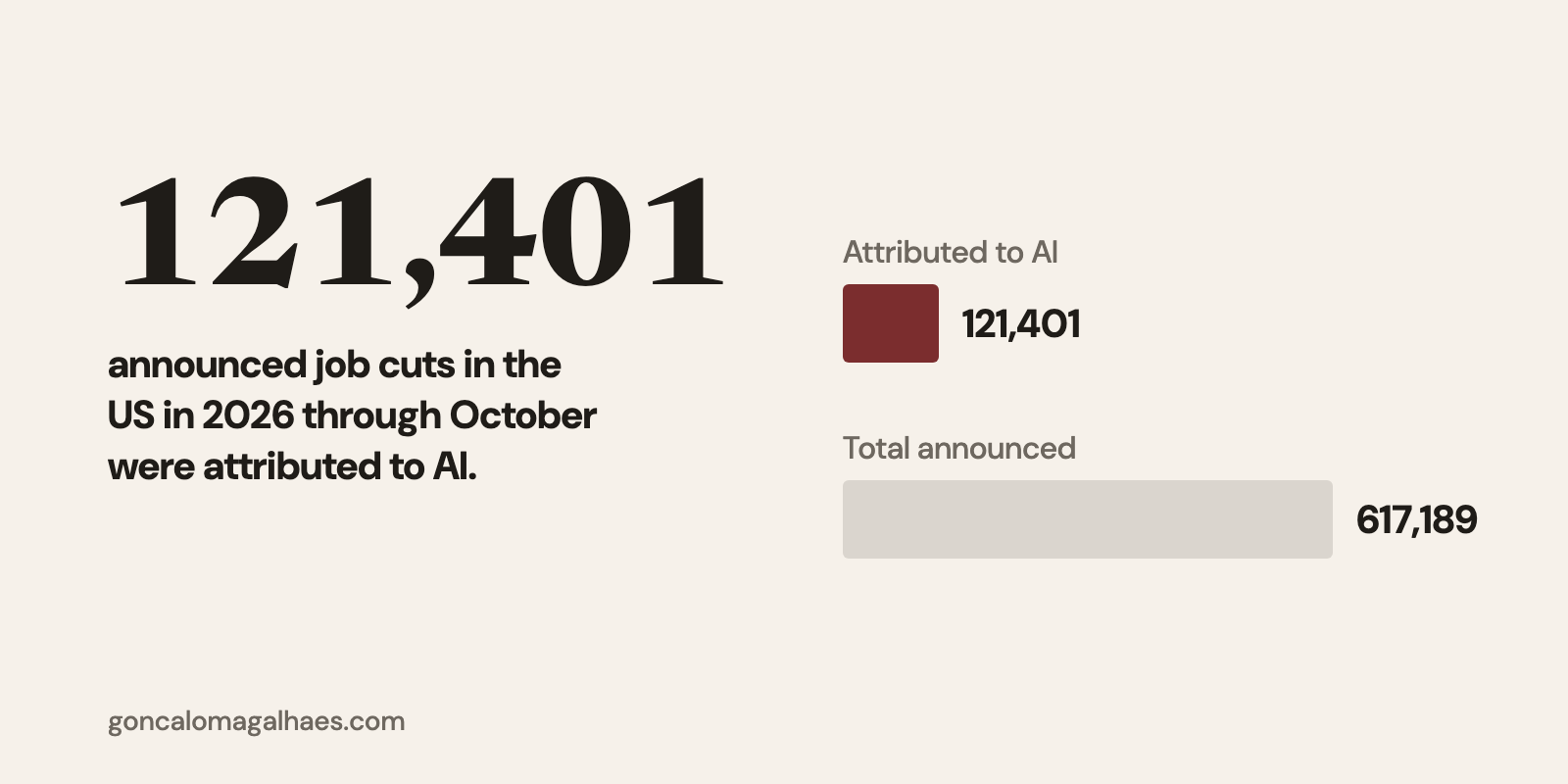
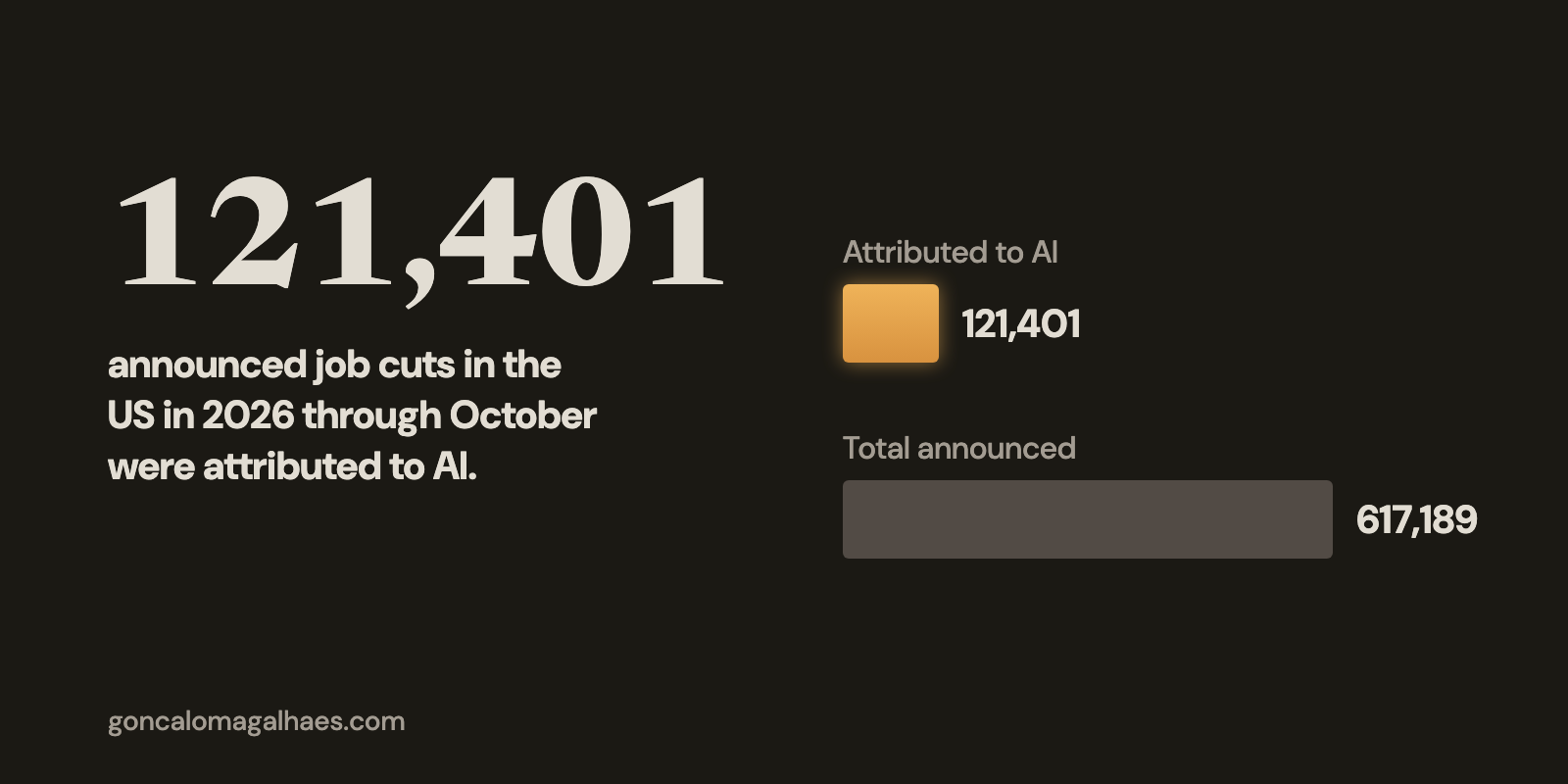 Data: Challenger, Gray & Christmas, November 5, 2026.
What gets lost when you automate too much
When you automate too much, the quality of some processes or of certain outputs sometimes drops. We've also seen this when it comes to the worker: if, because of AI, they're parallelizing too many things, there's too much context switching, they can no longer do deep, higher-level work and, at the extreme, they become a fairly replaceable orchestrator.
It's normal to err on the side of too much in these cases. Overall, it even seems to be preferable to not automating enough, as long as the excess gets corrected afterward. It calls to mind how Elon Musk used to say to simplify and delete to the point of then having to redo some things. During a tour of the SpaceX factory in Texas, in 2021, he declared: if you don't have to add things back in at least 10% of the time, you're not cutting enough.
One public case of a corrected excess is Klarna, a Swedish installment payments company. In 2024, it announced that its AI assistant was doing the equivalent work of 700 people in customer service. In May 2025, it went back to hiring people, and the CEO admitted that too much weight had been given to cost and that quality had dropped.
With AI, anything is possible, and the company hires again
In a more advanced phase, a company's leaders realize something that typically comes across as a nightmare for the rest of the workers: with AI, anything is possible. Literally.
That experiment that used to need new hires and months to test, which on its own meant it was never even attempted, now needs an MVP (minimum viable product) built in a day by one of the existing workers, with the help of AI, and tested with real customers in maybe a week. Because of this, a whole load of things can suddenly land on the list of immediate tasks that take little effort and could bring a big return. It's never been so easy to follow the old entrepreneurial advice: fail fast.
And, for this very reason, the company that's advanced in its use of AI wants to hire new people. Not necessarily specialists in a specific technical subject, but flexible generalists, able to think well and to execute quickly and at a high level.
Why a nightmare? Typically, when leadership or a CEO dreams of going further and bringing more projects into the company, workers feel they'll have more work and more pressure. The temptation is to want to stay comfortable in what they already know how to do, which doesn't bring much that's new or many complicated problems. This tendency shows up more in the workers who would rather just execute what they're asked to do than think and have ownership of the company's future and success.
It's natural for leadership to think beyond the company's BAU (business as usual, the day-to-day work). And it's also natural for that to cause a bit of a stir among those who are deeply settled into executing that BAU well.
The junior has to prove they can think and create
I recently saw a job ad on LinkedIn from The Diary of a CEO, the podcast of British entrepreneur Steven Bartlett. They were looking for "AI-native creatives" with "insane taste" who could "spot slop from a mile away": the generic, low-quality content made with AI. This is what a company wants now, or at least one that's in that third phase.
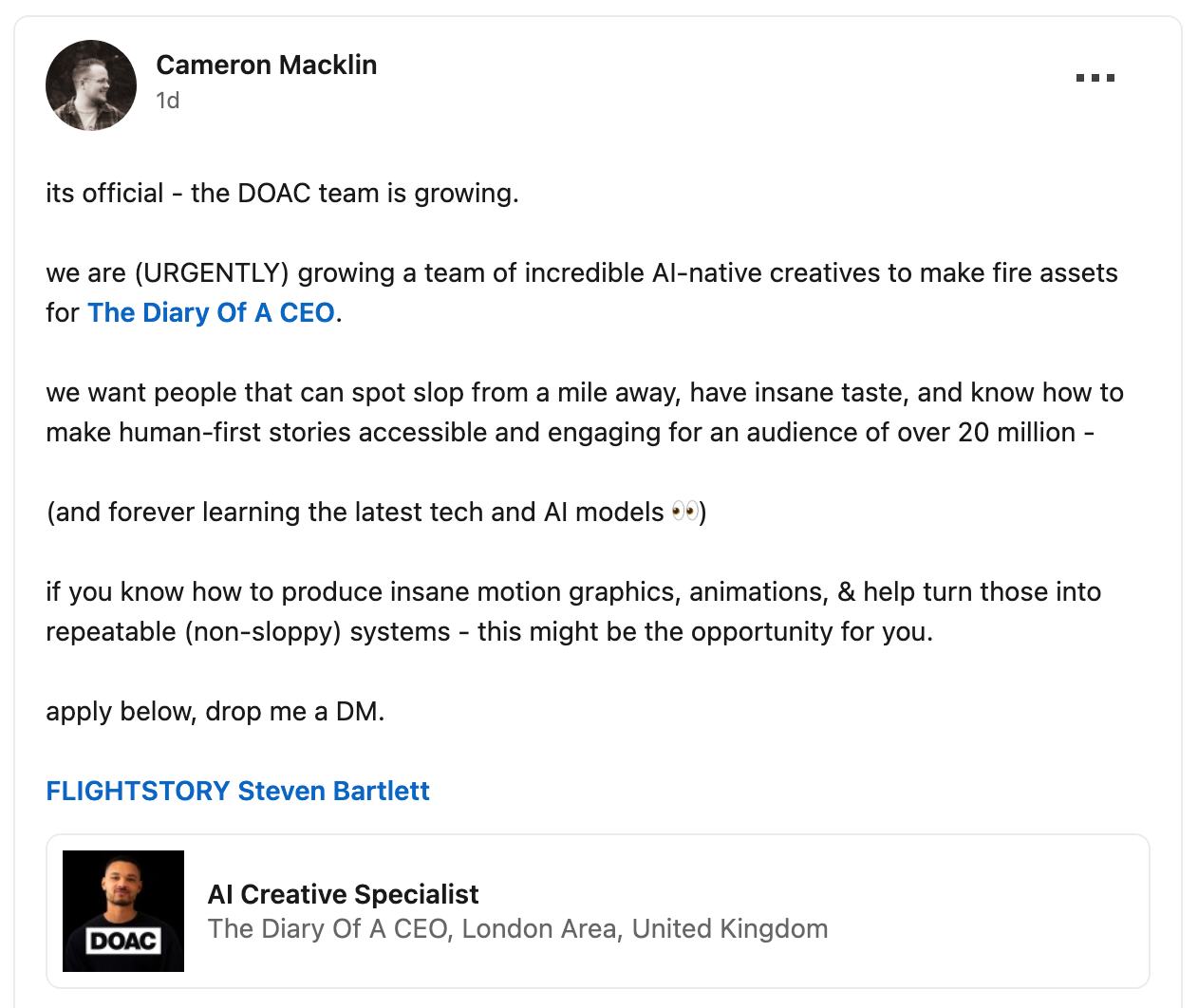 Source: Cameron Macklin on LinkedIn, November 24, 2026.
Where does that leave the junior? Well, with a much harder time getting into the knowledge work market. That's because it's increasingly not enough for a person to know how to execute, since AI knows how to execute. You have to think and create at a much higher level, and the junior doesn't have the experience to prove that.
On the one hand, new workers have to adapt and find ways to prove it. On the other, hiring tests themselves will have to know how to identify it in new people. I haven't thought this through yet, but you'd have to build some kind of assessment that figures out how the candidate will use AI: whether they use it to go fetch the slop answers or to build even more value.
Shrinking or growing depends on the phase the company is in
AI has unequivocally brought disruption to the business environment. A company that doesn't know how to adopt this new technology seems to fall behind like a company that didn't know how to adopt computers or the internet. Depending on what phase a company is in with AI adoption, it may be on its way to contracting in number of workers or to expanding and, with that, opening up a whole range of new possibilities never taken seriously before.
It's also up to the workers themselves to know how to adapt, and to be able to show the value they have for the business world amid changes so frenetic that they promise to wipe out the junior technical specialist.