In the Competition for Your Attention, You Rarely Win
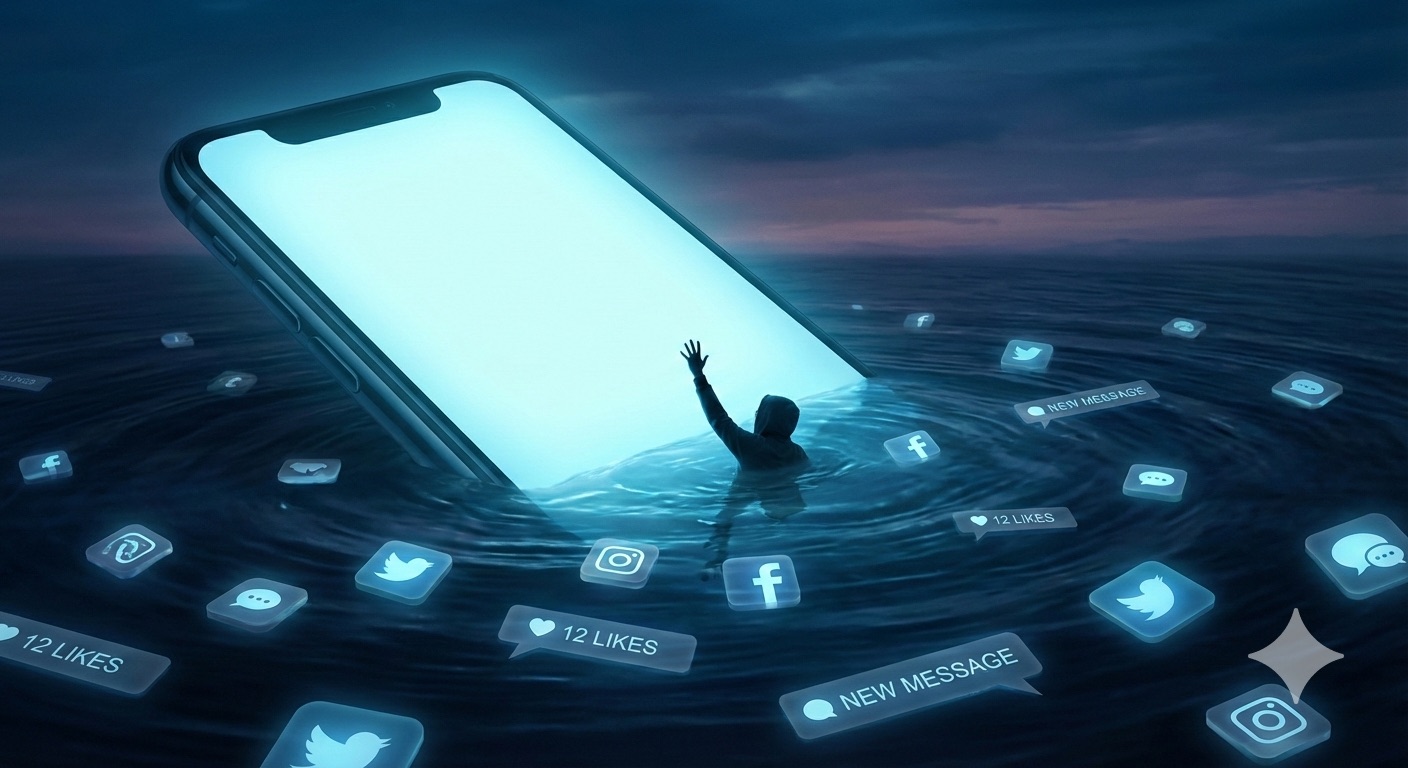
In the industry where I work, having a Twitter account lets me stay on top of the latest developments and make myself known to others. So it's a necessity - or at least that's what I frequently try to convince myself of, every time I watch my time sink into an endless scroll of random content…
Here's the drama that happens to me at least once a week. Someone on my team shares a highly relevant tweet about some AI development. Intrigued, I open it and read the tweet. Sometimes it even links to an article or a new tool I'd like to try, so I bookmark the post. But at the same time, my eyes are drawn to another tweet showing a video of someone doing something incredible - I can't just ignore it, or I might lose it forever! This is me rationalizing my actions, because in reality I'm not thinking about anything at all in that moment. And the same thing happens again, and again… Thirty minutes later, I realize I had gone to Twitter to do something, but I can't quite remember what. I go back to the work chat. Oh right, my colleague had shared this interesting development!
What happened to me isn't a lack of discipline. It's the result of a silent war over the most valuable resource in the market: your attention.
The War for Your Attention
It won't come as news to anyone that the vast majority of society spends more time on their phone than they should, or more time on screens than is ideal. This isn't by accident, but it also isn't necessarily because the tech industry wants people to waste time in their lives. Maybe that thought never even crosses their minds, though in certain fleeting moments of self-reflection, it crosses the mind of even the most die-hard Apple fan or Stranger Things binge-watcher.
What is certain is that when the personal computer arrived in people's homes, the fascination (and, let's be honest, the utility!) was such that it came to occupy a substantial part of family life. The same goes for television, which even rearranged the layout of most living rooms. However, whether we wasted time on these technologies or not, we could walk out the front door and completely disconnect from their influence.
With the arrival of smartphones - in particular, the disruption brought by the first iPhone in 2007 - access to the internet and media content moved into the user's pocket. And with that, it became possible to remain continuously "connected," continuously online. Or seen from another perspective, it became hard to disconnect from the influence of these technologies.
Now, anyone who has ever decided to cut down on scrolling through Instagram or TikTok, or chatting with friends on WhatsApp, or watching YouTube videos, has certainly faced a devastating reality: it's brutally hard. We ask ourselves: why is this? Why do I decide one day not to spend much time on YouTube, and the next I'm watching shorts for an hour? How did I say this was the last episode I'd watch tonight, only to give in and start the next one?
The Trap
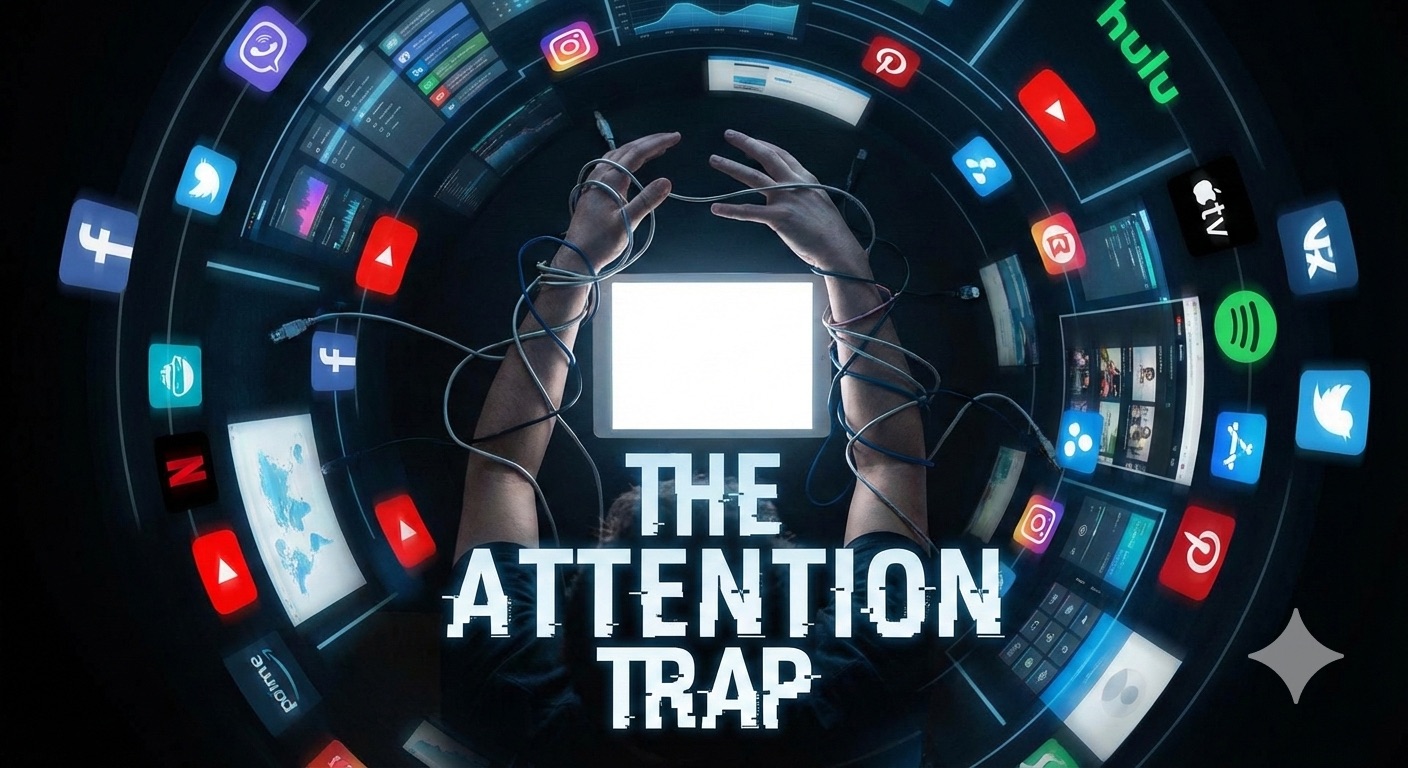
The answer is simple: these technologies and these companies do EVERYTHING to capture your attention. They exist solely to retain you indefinitely on their platforms. When you try to control the time you invest in these apps, you're actually fighting an absolutely Herculean battle. You're a young David taking on a giant Goliath. It's not that you lack self-discipline, it's that they are relentless. Yes, you have an imperfect nature, but they do nothing other than study how to exploit it.
This realization led Jake Knapp and John Zeratsky to conclude in their book Make Time: "Willpower alone is not enough." Experienced product designers at Google, they call these bottomless technological wells Infinity Pools:
"Infinity Pools are always-on, effectively infinite sources of replenishing content. Your phone, your laptop, and your television are brimming over with games, social feeds, and videos. Everything is just a click, a tap, or a swipe away; irresistible, even addictive. Every bit of friction is smoothed away."
This default doesn't only show up in new technologies. Indeed, a messy desk cluttered with stuff also offers our minds various means of distraction. However, the desk's existence doesn't depend on keeping us distracted. On the other hand, essentially anything we touch on our computer or phone survives only if it can retain our attention - which will invariably distract us from the real world or other facets of life.
The reality of the situation is that there are two types of people: those who can perfectly master these technologies without being influenced, and those who can't…
And the first type doesn't exist.
Getting Out of the Water…
The problem isn't just the distraction - it's what it costs us: time for the things that matter most.
Where does our life actually go? "Are we all just stuck on autopilot?" (Make Time) Don't we so often dream about having time for certain pursuits, certain activities we'll do "someday"? And while we're running out of time, don't we reach the end of the day and think: what did I actually do today?
The solution lies in adding some intentionality to our lives, instead of constantly letting ourselves be dragged by the current. But if in some cases the current is too strong, it's better to get out of the water, or never get in at all!
There's something strange, perhaps even pathological, about the world's aversion to the idea of uninstalling apps from our phones. On one side of the scale, we have social media and other apps injecting infinite content into our brains, draining our time and mental energy with low returns on the investment. On the other side, we have not constantly keeping up with everyone else's lives, not responding to a message immediately, and having nothing to do while standing in a queue. If the current is dangerously strong, why not simply step onto dry land? We can perfectly well say no to what Cal Newport calls digital Oreos:
"These are digital Oreos; delicious, but something we should have no problem pushing aside and saying, 'I don't eat that junk.'"
John C. Maxwell compares time to a block of marble:
"Time is like a block of marble. Give a block of marble to an average person and you end up with... a block of marble. But place it in the hands of a master sculptor and watch what happens! The sculptor looks at it with the eyes of an artist. First, he decides what he will create. Then, he practices the disciplines of his craft until he has turned lifeless stone into a masterpiece. I believe you and I can become like the sculptor. We can learn to be master craftsmen - not of stone, but of our lives." (Today Matters)
In the fierce technological competition for your attention, you rarely win. Say no to what you can, and build systems in your life that reward intentionality. On the other side, all that awaits you is a calmer, more rewarding, more intentional life, and truly yours. Fernando Pessoa, through the voice of Ricardo Reis, captured this better than I ever could:
To be great, be whole: don't exaggerate
Or leave out any part of you.
Be complete in each thing. Put all you are
Into the least of your acts.
So too in each lake, with its lofty life,
The whole moon shines.
- Fernando Pessoa (translated by Richard Zenith)